Wednesday, November 2, 2022

Where using and preserving the coast find common ground

        When then-Governor Donald Carcieri announced in 2007 that Rhode Island was going to host the nation’s first offshore wind farm, he turned to the Rhode Island Coastal Resources Management Council (CRMC)—the state’s regulatory agency for coastal issues—to develop the necessary policies, plans, and regulations to make it happen. And, as the council had done for nearly 40 years, it turned to the University of Rhode Island’s Coastal Resources Center (CRC) for assistance.
        Over the next two years, CRC staff created what they called an Ocean Special Area Management Plan (Ocean SAMP), the nation’s first effort to develop a zoning plan for offshore wind in a marine region. The complex initiative included research by URI scientists into such diverse topics as marine geology, bird and whale migration, fish spawning, commercial and recreational fishing, shipping, cultural heritage, and tourism to identify the best location for a wind farm and a site that would create the least conflict with other user groups. 
Fishing canoes on the coast of Ghana

        “It was a comprehensive look at our ocean and coastal resources and an enforceable plan to ensure that the way we develop that area of the water is balanced and considers the implications for the people of Rhode Island,” says Jennifer McCann, M.M.A ’94, the director of U.S. Coastal Programs for the Coastal Resources Center. “While it was driven by the governor’s desire to see offshore renewable energy off our coast, it wasn’t just about wind farms. We were able to increase the protection of various areas of our coast for economic development, for cultural reasons, and for environmental reasons that had nothing to do with offshore wind.”
        That’s one reason the CRC has earned such respect and been so successful in the projects it has undertaken through the years. It has approached every coastal issue as a neutral observer, without preconceived notions, and with the needs of all stakeholders in mind. As a result, stakeholders buy into the process and are more likely to support the resulting decisions, even if they don’t get everything they want in the end.
        "When the wind farm developers went to get their final permit, the environmentalists and the commercial fishermen and the Narragansett Tribe were all standing shoulder-to-shoulder saying, ‘We support this as long as you follow the Ocean SAMP,’” McCann says. “We had built this constituency that understood each other and supported each other, even though they came from different places. It’s a great example of...


Friday, June 10, 2022

Songs of nature provides performance that won't be forgotten

        It was a magical evening. Standing on the edge of an overgrown field in Exeter last month, my wife, her cousin and I prepared for an unusual performance.
        The daytime birds were wrapping up their springtime singing for the day. A prairie warbler burst forth with one more buzzy, upslurred note; a towhee whistled its “drink your tea” call; and a gray catbird chattered as dusk approached. In the distance, a turkey joined the chorus.
        After the sun set and the sky turned to a mix of peach and violet, what I thought was a barking dog turned into a howling pack of coyotes, yipping and yapping until a second pack responded from the opposite direction. Then a barred owl chimed in, demonstrating its classic “who cooks for you” call. The performance had already reached a high point, and yet the stars of the show hadn’t even arrived.
        At exactly 8:12, a chuck will’s widow blasted us nearly off our feet with its first of hundreds of calls. It must have been just a few yards away from us, hidden in the brush or a nearby tree. The unusual bird, a member of the nightjar family, is only found in this one place in Rhode Island, and it only sings for a few short weeks. And what a song. That’s what we had come to hear.
        Its name comes from what some early birdwatcher thought its call sounded like. It starts with a sharp “chuck” note, followed by a shaky whistled “will’s widow,” then repeats it on and on. It was still going when, three minutes later, its cousin the whippoorwill — another bird whose name is derived from an interpretation of its song — started calling about 100 yards away. A second whip joined in from across the field.
        And then the chuck went silent. We stared toward the tree we thought it was calling from, and then it started calling from a different direction. Was it a second bird, or did the first one move without us noticing? Almost certainly the latter. But how did it move without us seeing it? It had to have flown very close to the ground to avoid our eyes.
        We remained enraptured by this unusual performance until darkness had nearly enveloped the area. As we nodded in silence that it was time to go, we remembered that there was still one performer we hadn’t heard yet. Just seconds later, the distinctive “peent” of an American woodcock, a chunky shorebird that never spends time at the shore, resounded nearby. His odd call, repeated every 10 seconds or so, concluded an amazing hour of birdwatching.
        Yet we didn’t actually watch anything. Not one bird did we see. It was an entirely auditory experience. But that sure didn’t detract from the show. It may have even made it more special.
        The excitement of the experience was a fitting conclusion to my 50 years of wildlife observation in Rhode Island. Soon I’ll be moving to the West Coast to seek and learn about the wonderous wildlife the opposite coast has to offer.
        It also means that this is my last Backyard and Beyond column. I’ve enjoyed writing it for the last seven years, and I hope you’ve been inspired to pay a little closer attention to what goes on in the natural world. There is so much we can learn from the wildlife in our backyards and beyond. All you have to do is keep your eyes open for whatever may be around. I know that’s what I’ll be doing.

        This article first appeared in The Independent on June 9, 2022.

Friday, May 13, 2022

Tidepool life has changed dramatically in recent years

        It’s one of my fondest childhood memories — wandering the rocky coastline of Rhode Island and exploring the tidepools to discover whatever creatures may be in residence. It was always exciting to spot a crab or sea urchin or a few minnows, and even better when a starfish made an appearance.
        Yet while those same tidepools remain in the same places, like Brenton Point in Newport, Beavertail in Jamestown or Black Point in Narragansett, the marine life that call those nooks and crannies home have changed dramatically.
        Sure, those little round, blue-black snails — officially called periwinkles — are still in abundance. There might even be more of them now than when I was a kid. But as common as they have been for more than 100 years, they aren’t native to our shores. They were introduced from Europe in the 1800s and may be the reason why we have so many bare rocks along the coast. Before the arrival of the periwinkles, most of those boulders would have been covered in lush green algae. But the snails ate most of it.
        Nonetheless, periwinkles are just about the only reliable creature to be found in our tidepools these days. The crabs that were common back in the day, like hermit crabs and rock crabs, have been mostly replaced by non-native species, especially Asian shore crabs and green crabs. The new arrivals aren’t big, nor are they likely to nip your little fingers. In fact, the shore crabs aren’t aggressive at all, and the green crabs only fight among themselves. They’re both more likely to hide under a rock when approached by human hands than to lash out.
        The same is true of the purple sea urchins, the dome-shaped animals with the spiny shell that are not uncommon in tidepools. They’re slow-moving and feed exclusively on algae and detritus on the seafloor, so there’s nothing to fear from these unique invertebrates either.
        The good news is that researchers think that urchins are resilient to warming temperatures and ocean acidification, so their populations aren’t likely to decline much from the changing climate. A University of Rhode Island researcher is even investigating whether they could be profitably raised in aquaculture facilities in Narragansett Bay to help harvesters diversify their crop.
        The biggest disappointment to tidepool watchers like me has been the disappearance of starfish. Also called eastern sea stars, the once-common starfish was always considered the most prized of the tidepool creatures in my younger days. Their rough texture and hundreds of tiny tube-like feet on their undersides was always fascinating to me. And then to learn that they can regenerate an arm when necessary and pull open the shells of clams and other mollusks was too much to believe.
        Sadly, they, too, have mostly disappeared from our tidepools and shorelines. Back in 2013, a graduate student at URI collected some to study and found that they melted away in her tank and died within days. It was the first observation of a disease that ravaged starfish populations throughout the East and West Coasts. While there is evidence that the animals are recovering slightly, we’re still a long way from those joyous days of commonly observing these wonderful creatures in our tidepools.
        Despite the changing species and populations, however, investigating tidepools remains a fun family activity that everyone can enjoy. To ensure the health of the animals, it’s probably best not to handle whatever you find there. But don’t let that stop you from exploring this amazing marine world.

This article first appeared in The Independent on May 12, 2022.

Wednesday, April 20, 2022

Story of bird lives revealed in beaks, feet

        As hundreds of millions of birds migrate into the Northeast over the next few weeks, those who spend time watching them are enthralled by their stunning colors, their beautiful songs, and their remarkable physiological adaptations that enable them to complete their journey. But few people spend much time thinking about bird beaks and feet, and yet those body parts tell us a great deal about how and where birds live and what they eat.
        Let’s start with their feet.
        Most songbirds, like robins and chickadees, have feet with three toes pointed forward and one pointed backwards. That’s an indication that these birds are perching birds. When they’re not flying around, they typically perch crosswise on a branch and grasp the branch by wrapping three toes around the front of the branch and one behind it.
Nashville warbler (Todd McLeish)
        But not all birds that spend time in trees do that.
        Woodpeckers, for instance, have two toes pointed forward and two toes pointed backwards, which better allows them to climb up the side of tree trunks and even cling upside down beneath branches. Nuthatches behave in a similar way, so their toe arrangement is also two forward and two back. Simply by noticing their toe arrangement you can tell how birds move around in a tree.
        The webbed feet of waterfowl is another obvious indication of where and how these birds live and move. As any child probably knows, webbed feet help birds paddle efficiently in the water. And for those ducks that dive underwater to catch fish or shellfish, webbed feet can be used to speed through the depths to capture their prey and navigate the underwater world.
        The claws of hawks and owls are also a clear sign that these are predators that capture and kill small mammals with their feet. So not only do bird feet tell us something about how they behave in a tree, but in this case, they also tell us what they eat.
        In most other birds, it’s their beak that reveals what they eat or where they find food. The big chunky beak of a cardinal announces to the world that it is a seed eating bird and that it opens seeds by crunching down like a Christmas nutcracker and crushing the outer shell of the seeds to access the inner goodness. Most sparrows, finches and buntings have a similar – albeit smaller – beak, which tells us they, too, are seedeaters.
        My first experience holding a cardinal was in an ornithology class many years ago. While attempting to place a metal band around the bird’s leg, it grabbed ahold of my knuckle in that massive beak and tried to crack open my finger like a walnut. It didn’t work, but it sure did leave a painful mark and, sad to say, forced me to let out an embarrassing yelp. Lesson learned; keep fingers away from seed-crunching birds.
        The beaks of other birds also tell us about their food preferences. The large, hooked beaks of hawks are used for tearing apart flesh; the long narrow beaks of many shorebirds are ideal for probing into the sand; the wide beaks of flycatchers and swallows are great for catching insects in flight; and the spatula-like beaks of ducks are useful for filtering algae from ponds. Without knowing anything else about these birds, a quick glance at their beaks gives away what they eat and how they find it.
        I’m not sure human mouths and feet tell a similar story. Or if they do, it’s not a story I’d want to read.

This article first appeared in the Newport Daily News on April 18.

Friday, March 25, 2022

Erratic winter weather confuses local wildlife

        It happened again. We had another crazy winter that alternated between heavy snowfall, record-breaking warmth, and icy cold temperatures, which is once again causing us to question how we define winter weather in New England.
        It’s seeming like we’ll never again have those long stretches of sub-freezing temperatures that allow our ponds and lakes to freeze solid and give everyone the opportunity to lace up their ice skates and slide across the ice. When I was a kid, everyone knew how to skate because pond skating was so readily available in just about every neighborhood. But now, fewer people skate because it’s so inconvenient to learn and practice. Our ponds seldom freeze thick enough anymore to withstand the weight of a neighborhood full of skaters.
        Our increasingly erratic winter temperatures have not just made pond skating in Rhode Island a thing of the past. It’s also confounding the natural world.
        I saw numerous reports of crocuses blooming in mid-February when the temperatures hit the 60s for several days in a row. Trees and shrubs in several places started to bud as well. And then they all had to go dormant again when the cold temperatures returned.
        Early-blooming spring flowers and shrubs are used to the variability of the New England weather, though, so they aren’t likely to be harmed by their efforts to make an appearance weeks before they should. But the energy they wasted trying to grow and bloom in February may mean they don’t have the energy to try again at a more appropriate time. And as a result, our usual springtime colors may not be as bright or abundant this year. And that seems to be happening more and more often.
        It’s not just the vegetation that’s getting an early workout from the unusual swings in winter temperatures, however. Some animals are likely struggling, too.
        Wood frogs have the remarkable ability to freeze nearly solid during the winter and then thaw themselves out as spring approaches. They’re the earliest active amphibian in our area, typically arriving in local ponds in mid- to late-March to breed. To me, they’re the surest sign of spring we have left.
        But when spring-like temperatures arrive for a few days in February, the frogs are triggered to thaw themselves out. And when they realize they’ve jumped the gun, they have to refreeze. The more often they do that, the less likely they will emerge unscathed once winter is truly over. And these days they find themselves thawing and refreezing several times each year, which wreaks havoc with their physiology.
        The situation is similar for two other local amphibians that migrate to local breeding ponds in late March – spring peepers and spotted salamanders. I swear I heard a peeper calling in February, which doesn’t bode well for the little guy. They’re struggling to detect when the time is right to emerge from their winter hibernation. As are woodchucks and skunks, chipmunks and garter snakes, and a whole host of other creatures.
        And let’s not forget the migratory birds, many of which must make an educated guess about the weather hundreds or thousands of miles away to decide when to begin their long flights. And if they arrive too early or too late for the emergence of their preferred insect food, then their breeding season may be a bust.
        Hopefully most of these creatures will figure out our new normal for winter and spring weather before it’s too late. I just wish the same could be true of pond skating.

This story first appeared in The Independent on March 19, 2022

Monday, February 14, 2022

This winter, let’s try not to get too mad at the bird feeder thieves

        If you devote much attention to feeding the birds that visit your yard, it’s highly likely that you’re not a fan of squirrels. The little buggers always seem to hog the feeders, keep our favorite birds away, and consume way more than their share of seed. I’ve concluded that about a third of my bird feeding budget is consumed by the gray squirrels in my backyard, with a little help from chipmunks and an occasional red squirrel.
        As much as I claim that I’m not bothered by the innumerable small rodents eating from my feeders — and, in fact, I even tell people that I enjoy watching their antics — it’s not as true as I’d like it to be. More often than not, I want to run out the door and chase the squirrels away whenever I see them. But I don’t. At least not very often.
        Nonetheless, they’re intriguing animals. They seem to thrive in our cold and snowy winters and
Red Squirrel (Todd McLeish)
prosper, whether I keep my feeders full or not. And when we have a good year for acorns, as we have the last two or three years, they thrive even more.
        Gray squirrels obviously don’t hibernate. They’re out there raiding the feeders all winter long. Even in neighborhoods where no one maintains bird feeders in the winter, the squirrels are still abundant and healthy. That’s because they can stay warm by relying on their fat reserves and by eating the scattered mass of acorns and other seeds they’ve stored during the fall.
        At night, they retreat to leafy nests in tree holes and elsewhere in the forest to sleep. When the weather is especially nasty, they may gather in those nests —called dreys — in groups of two or three or four to keep each other warm.
        I can usually count on seeing six or seven gray squirrels eating the sunflower seeds in my bird feeders every day in winter. I call one of them white ears, because it has bright white fur on the back of its ears. It’s so bold that it doesn’t stray far from the feeders when I go out to refill them. And it doesn’t seem to be bothered by my cats whining from the kitchen window whenever it’s nearby. It’s hard not to admire the little fella.
        I am less bothered by the chipmunks that are also regulars at my feeder, partly because they aren’t visible for much of the winter. They spend most of the cold months sleeping in their burrows, feeding on the seeds they’ve stored there, and only occasionally emerging to scavenge from the spilled seeds during warm spells. Chipmunks are adorable as they fill their gigantic cheeks with seeds each fall, running back and forth from the feeders to their burrows to cache their loot. The cuteness factor, and their diminutive size, makes it difficult to hate chipmunks, even though they, too, are bird seed thieves.
        My favorite of the mammalian visitors to my feeders are the flying squirrels. Occasionally when I turn on my back porch light before going to bed, the light will illuminate the antics of the flying squirrels as they soar from tree to tree and grab a seed or two. If I could see them more easily, I’d be happy to supply even more seeds to keep them around more often.
        Despite the cost of bird seed, I can’t help but be pleased that I’ve created a somewhat safe environment for my neighborhood feeder thieves. Even the squirrels.

This article first appeared in The Independent on February 12, 2022.

Friday, January 21, 2022

Rare birds keep finding their way to the Ocean State

        Southern New England has been a hotbed of unusual bird sightings in the last couple years, with oddities showing up far off course from where they should be. Strangely enough, a handful of different species have turned up in our area when they should be 5,000 miles away in Siberia.2
        The latest was last month’s appearance of a Steller’s sea eagle on the Taunton River in Dighton, Massachusetts. The massive bird — similar to our bald eagle, but much larger, with a white tail but no white head ­— should have been on the coast of eastern Russia, Korea or Japan. But one lone individual has been wandering North America for a few months, appearing in Texas and Nova Scotia before stopping off just across the Rhode Island border for a day or two.
        It’s not the only one. A University of Rhode Island student stumbled upon a sharp-tailed sandpiper in Galilee in November, a bird that breeds in Siberia and winters in Australia. And a brown booby — a bird that should have been in the Caribbean — was observed on Fox Island in Narragansett Bay last fall. How these birds got to Rhode Island is anybody’s guess.
        The summer of 2020 had three more shorebirds from Eurasia making brief appearances in South County – a red necked stint, a little stint, and a Terek sandpiper. None had been seen on the East Coast 
more than a handful of times before, and it’s unlikely that any of them found their way back to their native range and reconnected with other members of their species.
        A few months later, a common cuckoo was found in Johnston, and it was anything but common. The European species had only been observed in North America two or three times before.
        All of these sightings generated tremendous enthusiasm among the birdwatching community, not just here in Rhode Island but all over the eastern U.S. and beyond. I talked to a birder from Indiana who drove through the night to see the sharp-tailed sandpiper, and as I joined 100 other birders searching – unsuccessfully – for the sea eagle, I noticed cars from a dozen states at a park where the bird had been observed the day before.
        While these super-rarities attract widespread attention, they aren’t the only unusual birds that keen-eyed observers have been finding. At least once a month, another out-of-range bird is discovered in the Ocean State. Some are species that don’t belong here but that seem to show up every year or two, like the pink-footed goose from Europe, the painted bunting from Florida, and the dickcissel from the Plains States. Others, like the western tanager seen in Westerly beginning last month, are species seen only once a decade or so.
        Why do these birds go so far astray? There are lots of possible explanations. Maybe their internal compass is off kilter and instead of flying south for a couple thousand miles, they fly east instead. This is probably the case with some juvenile birds making their first migratory flights. Or maybe they get blown off course by a storm or land on a ship that carried them to the ship’s destination. Or perhaps they joined up with a flock of a different species and followed them to their wintering grounds.
        We’ll never know how most of these birds got to the wrong place. Sadly, most probably don’t survive long in these new environs. But it sure does get local birders – and even non-birders – excited to track down these rarities.
        I wonder what unexpected birds will show up in Rhode Island in 2022.

This article first appeared in The Independent on January 15, 2022.

Monday, January 10, 2022

Scientists, shellfishermen seek strategies to sustain dwindling bay scallop populations

        In the Great Salt Pond on Block Island, native bay scallops are thriving like nowhere else in Rhode Island. Scientists from The Nature Conservancy survey the 673-acre tidal harbor every autumn and have recorded hundreds of scallops each year, despite as many as 50 recreational shellfishermen harvesting scallops from the pond each November and December.
        The same cannot be said of the rest of the Ocean State’s waters, however, where bay scallops are few and far between.
        On Block Island, Diandra Verbeyst leads a three-person team of Nature Conservancy scuba divers and snorkelers who monitor 12 sites around the Great Salt Pond. They have counted an average of 225 scallops annually since 2016, up from just 44 observed by previous observers in 2007, the first year of monitoring.
        “There are slight rises and falls from year to year, but the population is pretty stable,” Verbeyst
said. “Based on the 12 sites we monitor, the population is indicating that there is spawning happening each year, and there is recruitment to the population.”
        In addition to scallop data, Verbeyst and her team also collect information on water quality and other environmental conditions during their surveys.
        “The scallops are an indication that the ecosystem is healthy and doing well, and for me, that’s fascinating in itself,” she said. “No matter where you are in the pond, there’s a good chance you’ll see a scallop.”
        Bay scallops are bivalve mollusks with 30-40 bright blue eyes that live in shallow bays and estuaries up and down the East Coast, preferring habitats where eelgrass is abundant. They are short-lived animals — most don’t live more than two years — and are significantly smaller than sea scallops, which are found farther offshore and are harvested by the millions by New Bedford, Mass.-based fishermen.
        Chris Littlefield, a Nature Conservancy coastal projects director and former part-time shellfisherman on Block Island, recalled collecting scallops as a child in the Great Salt Pond 50 years ago, and he has been gathering them in small numbers for his family’s consumption ever since. He said the scallop population received a boost in 2010, when immature scallops grown at the Milford Laboratory of the National Oceanic and Atmospheric Administration were dispersed into the pond in a project funded by the Natural Resources Conservation Service.
        “That project broke through some kind of threshold,” Littlefield said. “Scallops weren’t as abundant before that, and they used to be confined to certain key locations and that was it. But now they’re more abundant and more people are finding them and harvesting them.”
        Unlike Nantucket, Martha’s Vineyard, and a few locations on Cape Cod and Long Island, where regular seeding of immature bay scallops has resulted in thriving commercial fisheries, Rhode Island has a tiny commercial fishery for bay scallops — fewer than three fishermen participate — and the fishery is not sustainable.
        Anna Gerber-Williams, principal marine biologist for the Rhode Island Department of Environmental Management’s Division of Marine Fisheries, just completed the first year of a three-year effort to assess the state’s bay scallop population. She is focused primarily on the salt ponds in South County, especially Point Judith Pond and Ninigret Pond, which historically had healthy bay scallop populations.
        “We manage and regulate the bay scallop harvest, but besides Block Island, we haven’t had an actual assessment of what the population looks like in Rhode Island,” Gerber-Williams said. “We know it’s pretty low, and we know the actual commercial harvest numbers are very low. But we don’t have anything to base our management on. The hope is that this project can turn into more long-term monitoring, similar to what’s done on Block Island, and maybe lead to restoration efforts.”
        Based on her first year of surveys, Gerber-Williams said there are self-sustaining populations of bay scallops in Point Judith Pond, and their abundance can fluctuate significantly from year to year.
        “Scallops are very habitat dependent,” she said. “The habitat in the salt ponds is very patchy, and those patches are very small.”
        Unlike clams, which bury themselves in the sand, bay scallops sit on the seafloor and can swim around by rapidly opening and closing their shell, making them difficult to track and count. Gerber-Williams said they are threatened by several varieties of crabs, which can easily crush the scallops’ shells with their claws.
        “Part of the scallop’s strategy is to hide from the crabs in the eelgrass,” she said. “When they’re younger, they attach themselves to eelgrass blades to keep themselves above the bottom and out of reach of predators.”
        Dan Torre at Aquidneck Island Oyster Co. experimented this year with growing bay scallops in cages in the Sakonnet River off Portsmouth. He bought scallop seed from area hatcheries last July, and they are approaching marketable size now. He has contracted with one local restaurant to buy his experimental crop, with hopes of scaling up the operation next year.
        “I believe there’s a market, but it’s a niche market,” he said. “Normally with sea scallops, you sell just the shelled adductor muscle, but with bay scallops you sell the whole animal. The shelf life isn’t the longest, but it seems like there are a bunch of restaurants that are eager to try them.”
        In an effort to figure out how best to restore wild bay scallop populations in the region, the Rhode Island Commercial Fisheries Research Foundation is collaborating with The Nature Conservancy to synthesize what is known about the history of the bay scallop population and fishery in Point Judith Pond.
        According to Dave Bethoney, the foundation’s executive director, it will be combined with information about scallop fisheries in Massachusetts and Long Island, N.Y., as a first step to developing a restoration plan.
        “How to make them sustainable is the real puzzle,” Bethoney said. “Even successful efforts on Long Island are based on a seeding plan — getting scallops every year from aquaculture facilities to replenish them. They have successful populations, but they’re not self-sustaining. I don’t know how we change that.”
        Gerber-Williams agreed.
        “In my opinion, the way to boost populations here and keep them at a level that’s sustainable for a good fishery in Rhode Island, we would have to have a seeding program similar to what they have in Long Island and Martha’s Vineyard,” she said. “Every year they put out thousands of baby bay scallops. They seed their salt ponds every single year to keep a decent fishery going.
        “So the next step for us would be to do that kind of seeding program in Rhode Island. We’re in the process of creating a restoration plan for various species of shellfish in Rhode Island, and my hope is that bay scallops are a part of that.”

        This article first appeared on EcoRI.org on January 6, 2022.

Thursday, December 23, 2021

Finding the Six Birds of Christmas

    ‘Tis the season for Christmas carols, and every time I hear the classic Twelve Days of Christmas, it has me wanting to go on a birdwatching adventure.
        The song features six birds, and while most aren’t native to Rhode Island – the song originated in England, after all – that doesn’t mean that they’re difficult to find nearby. At least some of them.
        Let’s start with the easy ones.
        You’ll have little trouble finding seven swans a-swimming in the winter months around here. Just stop by any of the larger ponds or calm coves, like Easton’s Pond in Newport, Trustom Pond in South Kingstown, St. Mary’s Pond in Portsmouth, or Apponaug Cove in Warwick. Almost all of the swans you see will be mute swans, a European species introduced to New England in the late 19th century. But there’s a slim chance you may stumble upon a native tundra swan as it migrates through to the Mid-Atlantic States. They look very similar.
        Six geese should also be easy, though they won’t be a-laying. Even seeing 600 won’t be a problem. Canada geese have become a nuisance in some parks, golf courses and turf fields, and winter is when they are at their most abundant in Rhode Island. Look for them at the same places as the swans, though also check the Slocum turf fields, the corn fields near Trustom Pond, Newport Country Club and Fort Adams State Park. And note that several other species of goose can also be found in Rhode Island in winter, including snow goose, brant and occasionally cackling goose, white-fronted goose and pink-footed goose.
        Although most birds sing primarily during the breeding season in spring and summer, finding four calling birds in December should be a breeze. Since the lyrics don’t mention a particular species, you could count any number of species that make noise in winter, like chickadees, titmice, nuthatches and sparrows. But note that the original lyrics to the song referred to four “colly” birds, which is believed to be an archaic reference to the European blackbird. In that case, you’re out of luck without a plane ticket.
        Three French hens are another story. It likely refers to Faverolles chickens, a French breed now primarily found in poultry exhibitions, though perhaps any domesticated chicken will do the trick in a pinch. Or better yet, search for wild chicken relatives, like wild turkeys, which can be found just about everywhere these days. Pheasants fit the bill, too, though the only place to find them in Rhode Island is Block Island.
        While there are plenty of mourning doves that come to bird feeders, finding two turtle doves will be especially difficult. Your best bet would be finding a Eurasian collared dove, a member of the turtle dove family that has been expanding around the country but hasn’t quite made it to Rhode Island in any numbers. If you happen to be traveling to Florida for the holidays, you’ll find them perching on utility wires throughout suburbia.
        Finding a partridge will also be challenging. No native partridges visit Rhode Island, but a few local game farms raise two species, gray partridges and chukars, to release for hunters. Occasionally a few escape and wander the area. A friend in North Smithfield had a chukar visiting his yard almost daily for a few weeks in September and October.
        But finding one in a pear tree is next to impossible.

This article first appeared in the Newport Daily News on December 20, 2021.

Wednesday, December 22, 2021

Scientists assessing how waterfowl interacts with aquaculture facilities

        As aquaculture operations expand in Narragansett Bay and Rhode Island’s salt ponds, questions have arisen about how ducks and geese are affected by the facilities. To begin to answer these questions, a University of Rhode Island doctoral student is tracking the movements of local waterfowl.
        “There haven’t been any Rhode Island studies yet, but studies on the Pacific Coast have found issues with diving ducks getting tangled up in netting used by aquaculture, and birds that have been deterred from areas that might otherwise be good habitat because of the activities of aquaculture operations,” said Tori Mezebish, a native of Maryland who is collaborating on the project with URI
Tori Mezebish with black duck
Professors Peter Paton and Scott McWilliams and officials from the Rhode Island Department of Environmental Management.
        She noted that previous studies have also observed sea ducks like eiders and scoters, which feed on shellfish, preying on oysters and other shellfish being grown by aquaculturists.
        “There’s also been some positive associations, like ducks and geese eating some of the aquatic vegetation that accumulates on the cages,” Mezebish said. “It’s a mixed bag of how the birds might interact with aquaculture.”
        Last winter, Mezebish attached transmitters to 30 black ducks and 30 brant, a species of goose that lives in salt water. This winter she will deploy an additional 30 transmitters on common goldeneyes, a diving duck. All three species are common during winter in Narragansett Bay, the salt ponds, and adjacent salt marshes.
        Most of the brant have returned from their breeding grounds in the Arctic, and several of them spend every day with dozens of other brant on the lawn at Colt State Park in Bristol. Others are spending most of their time in the Upper Bay and Providence River. The black ducks are just beginning to return to the area from Maine and southern Canada, and the early arrivals have been tracked to the salt ponds and the Galilee area.
        Mezebish is tracking the movements of each bird using a GPS unit on their transmitters to see how much time they spend near aquaculture facilities. She is also observing the birds in the field to validate the GPS data and see what the birds are doing around the shellfish farms.
        “The goal is to understand what is important to these species outside of the aquaculture facilities,” she said. “Maybe brant need shallow areas with submerged vegetation, so that may not be the best place to put an aquaculture lease.”
        In addition to Mezebish’s study, URI postdoctoral researcher Martina Müller is conducting land-based surveys throughout the year to see what other kinds of birds may be interacting with the aquaculture facilities.
        “Ultimately we want to provide recommendations about the good and not so good places for aquaculture leases to be placed,” said Mezebish, who became interested in waterfowl research as an intern at the Pawtuxet Wildlife Research Center in Maryland, where she hand-reared ducklings used in the center’s research activities.
        When the project is complete, Mezebish hopes to use the study as a springboard to study related questions about other conflicts and interactions between waterfowl and humans.

Tuesday, December 14, 2021

Grad student investigating distribution of one of Rhode Island's rarest turtles

        Wood turtles are among the rarest turtles in Rhode Island, and yet little is known about where they can be found in the state and what conservation strategies may boost their populations. A University of Rhode Island graduate student is taking the first steps in addressing those questions by surveying the state to identify local populations of the turtle and the habitat they require from season to season.
        “There has never been a statewide survey of wood turtles in Rhode Island before, and before we can protect them, we have to figure out where they are,” said Chloe Johnson, a native of Atlanta,
Chloe Johnson with wood turtle
Georgia, who is in her second year of studying the turtles as part of her master’s degree.
        Wood turtles, which have been proposed for inclusion on the federal endangered species list, are found from Virginia to southern Canada and west to Minnesota. Sporting orange patches on their neck and legs, they spend time in slow-moving rivers and streams as well as in terrestrial environments like forests, croplands and pastures. They nest in open sandy areas.
        Working in collaboration with URI Associate Professor Nancy Karraker and Scott Buchanan at the Rhode Island Department of Environmental Management, Johnson conducted upland surveys during the summer of 2021 in hopes of finding nesting turtles, and she scoured rivers and streams in fall and spring. So far, she has identified 13 locations where the turtles have been documented. But finding the turtles has been harder than she expected.
        “I’ve done more than 70 surveys and found fewer than 15 wood turtles,” she said. “They’re much more difficult to find than I anticipated. In the summer I went three weeks without seeing one. It’s hard, but when you find one it’s so much more rewarding.”
        In the upcoming field season, when Johnson finds a wood turtle, she will attach a GPS data logger on its shell so she can track its movements.
        “We want to know where the turtles go at night. Are they in fields or forests or streams?” she said. “How often do they cross roads? We’ve seen and heard from a lot of people that they’re seen crossing roads. Maybe we can find potential hotspots of road mortality.”
        According to Johnson, wood turtles are threatened by habitat loss and fragmentation from the construction of roadways, houses and other human-based development. Their streams are also being negatively impacted by these developments. In addition, their bright coloration makes them popular in the pet trade and a prime target for wildlife traffickers.
        “They’re endangered range-wide,” said Johnson, “but compared to surveys in Virginia, they’re much harder to find here in Rhode Island.”
        The URI student anticipates completing her wood turtle research by next fall, when she hopes to have located previously unidentified breeding areas that state wildlife officials can include in future management and conservation plans.

Monday, December 13, 2021

URI student takes birdwatching community by storm

        When University of Rhode Island senior Sam Miller discovered a sharp-tailed sandpiper at the Galilee Bird Sanctuary in Narragansett in November, it caused significant excitement among the birdwatching community. During the three weeks the bird remained in the area, hundreds of people from throughout the eastern U.S. flocked to see the bird, which breeds in Siberia and winters in Australia.
        Miller found the bird – a species never previously observed in the Ocean State – during an all-day event he organized in which dozens of local birders sought rare birds along the Rhode Island coast.
        “November is rarity season in the Northeast, so we targeted the most rarity-productive habitats in Rhode Island and hoped that someone would find something cool,” said Miller, a wildlife and
Sam Miller birding at Sachuest Point NWR (Peter Paton)
conservation biology major from Gambrills, Maryland. “I didn’t think I’d be the one finding the rarest bird, but other rare and uncommon birds were discovered as well.”
        The event, which he called a Rarity Round-up, is an annual event in his home state, and Miller wanted to launch something similar in Rhode Island.
        “Hopefully there was enough interest to make it an annual event,” he said. “It seemed to work out pretty well.”
        Miller has been interested in wildlife since early in his childhood, and he eventually obtained a camera to take photos of the birds at his birdfeeders. After flipping through a field guide to identify the birds in his photographs, he realized how many other species could be found, so he started looking for them.
        “I mostly go birding around Maryland and Rhode Island, but I take advantage of family vacations to do some birding, and last winter I road-tripped to Florida with friends to see birds there,” he said.
        He chose to enroll at URI after meeting the University’s ornithology professors, Scott McWilliams and Peter Paton and discovering that Rhode Island is an excellent place to observe fall migration. He has served as a teaching assistant in Paton’s field ornithology class for two years, and he is in the midst of a research project to learn about nocturnal bird migration and morning flight along the Rhode Island coast.
        “Most songbirds migrate at night, and as the sun rises, they descend to land,” he said. “Birds descending in the vicinity of Point Judith either continue their migrations to Block Island or land at the coast. In most cases, those that land at the coast continue flying farther inland in search of more productive habitat to refuel. Others may find the coastal habitat suitable and refuel there. At Camp Cronin on the Point Judith peninsula, I could study this decision making and see how it may be impacted by varying weather conditions.”
        Camp Cronin is where Miller spent his early morning hours in September and October recording the nocturnal flight calls of birds flying by for the two hours before dawn. He also conducted flight counts at sunrise and walked transects to document the species and numbers of birds that spent the daylight hours at the site.
        “I got more intensified morning flights when visibility was less than ideal to Block Island,” he said. “When there’s poor visibility, more birds seem to descend at the coast rather than continuing over water where weather conditions and the presence of habitat is uncertain. When birds descending at the coast can see across Block Island Sound, I believe many decide to continue their migrations to Block Island, but this will require further research.”
        “In my 26 years at URI, Sam is undoubtedly the most field-savvy undergraduate I have had the pleasure of working with,” said Paton. “He has an encyclopedic knowledge of the birds of Rhode Island. He has already established himself as one the most skilled birders in Rhode Island, and he has yet to graduate from URI. I am sure he will go far in the field of ornithology.”
        As a relative newcomer to Rhode Island, Miller made an extra effort to reach out to the local birding community, and he even helped start a text messaging group to quickly share information about interesting bird sightings. It not only helped him become acquainted with the state’s most active birders, but it also helped other new birders get connected to the community.
        With one semester left before graduation, Miller is looking ahead to graduate school and a career as an ornithologist.
        “I’m probably going to take a year to work and get some field jobs before going to grad school,” he said. “What happens after that is a bit up in the air. I’ve always thought about a career in academia, because I like to teach, but I’m going to take one step at a time and see what opportunities come my way. And I’ll take it from there.”

Boom in mouse population has implications for Lyme disease, predators

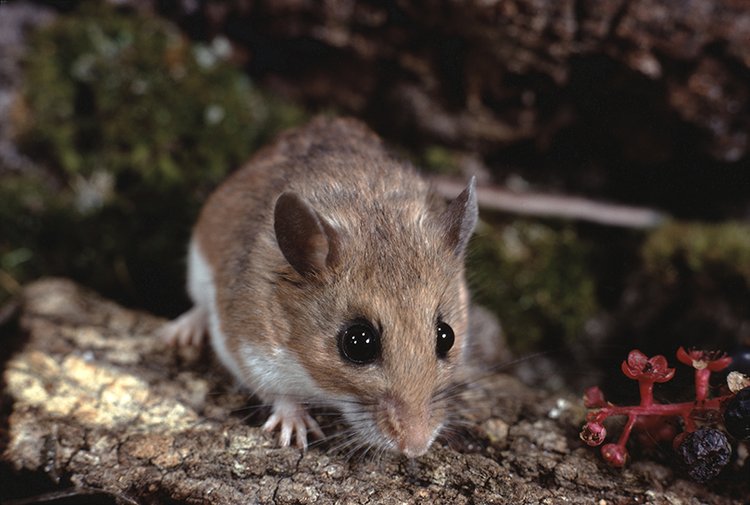
        A wildlife biologist at the University of Rhode Island has observed a significant growth in the local population of white-footed mice this year, which could increase Lyme disease risk next year while also providing additional food to area predators and increasing the likelihood that homeowners find mice in their basements.
        Christian Floyd, a URI teaching professor who studies rodents and other small mammals, said that his mammalogy class set 50 box traps in a forest to the north of the Kingston campus this fall, and in
Christian Floyd with white-footed mouse (Bailey Wolf)
one night they captured and released 24 white-footed mice. They typically capture no more than 6. The students also captured many more images of white-footed mice on trail cameras than usual.
        “Even in down years, this mouse is the most abundant mammal in Rhode Island,” said Floyd. “They’re everywhere – in fields, forests, farms, homes, everywhere.”
        According to Floyd, mice typically live short lives because they are the primary prey for many common predators. But because females can reproduce just 30 days after being born, and they can produce 3 to 4 broods of 4 to 8 babies per year, their populations can grow rapidly if the conditions are right.
        “A white-footed mouse outbreak is all about survival,” he said. “They have a high rate of being predated, but they seem to have survived better this year for some reason. The predator populations don’t really change, but what does change is their winter survival rates. The last couple winters haven’t been very severe, and that’s one important factor.”
        Floyd said that the abundance of acorns in the last two years has also provided plenty of food to carry the mice through the winter months.
        “Acorns are a major food source. They’ll eat seeds and other parts of plants, but it’s mostly acorns, and acorns were abundant this year and last year,” Floyd said. “That influences the size of their food cache for the winter.”
        The combination of high food availability, mild winters and their typically high reproductive rate has led to a banner year for mice.
        “What that means is a higher risk for Lyme disease and babesiosis,” he said. “Both are transmitted by black-legged ticks, but mice are the primary reservoir for the bacteria that cause those diseases. Mice transmit Lyme and babesia to the ticks.”
        Floyd said that homeowners should also expect a greater number of mice than usual in their basements and garages this year.
        “Since the weather turned cool, I’ve been catching about one mouse a day in my basement,” he said. “I’m up to 25 already. And that’s a problem, because they chew the wiring, they make a nest out of the insulation, and they get inside vehicles.”
        An abundant mouse population isn’t all bad news, however. Just as the abundance of acorns probably contributed to the increase in the mouse population, the abundance of mice will likely give a boost to wildlife populations that feed on mice, like hawks, owls, foxes and weasels.
        And by burying seeds and mushroom spores, mice also play an important role in supporting the regrowth of forests. So more mice could lead to healthier forests. But a lot will depend on the weather this winter.
        “It’s already looking like we’re going to have another mild winter, and that’s a good sign for white-footed mice.” Floyd said.

Friday, December 10, 2021

Nature writer cultivated craft on streets of New York

        Naturalist and writer Scott Turner credits his keen wildlife observation skills to the talents he developed out of necessity growing up in a tough neighborhood in the Bronx, N.Y.
        “I was a survivor among the anarchy of the 1960s and ’70s, and I survived through my observational skills, through my senses,” said Turner, who wrote a nature column for The Providence Journal for 11 years and for GoLocalProv.com for two more. “Over time, I realized that some of the things I saw — if a gang was coming or if someone had a gun and I had to get out of there — weren’t
Scott Turner
that different from seeing a bird of prey zip through the forest or noticing a berry hanging on a Virginia creeper vine. It’s the same sort of enhanced sensory experience. It’s not about survival any more but more like a celebration.”
        His curiosity about the natural world started during a life-changing moment when he was 11.
        “That’s when my parents sent me to day camp, which I found was so much more peaceful and so much safer than being on the street corner,” Turner said. “I was fascinated that this entire world was around me and I’d never seen it before. I never knew that so much could be in such a small spot. I was hooked from there on out.”
        Turner’s weekly column featured many of his nature observations in the Bronx, as well as those in Rhode Island and wherever he traveled. A collection of his columns, which ran from 2007 to 2020, have now been compiled into a book, Beauty in the Street: Nature Tales from the Neighborhood.
        He started writing his column following the death of longtime nature columnist Ken Weber. When The Providence Journal editors selected him to succeed Weber, he considered it a chance to finally speak.
        “There’s a story in the book about when I was 4 and wanted to show my dad a garden,” Turner said. “My dad was a rough guy, and I already knew not to talk with him, and he just told me to shut up. The column was an opportunity to not shut up any more.”
        Because he spent most of his life living in cities, Turner’s essays have a decidedly urban slant to them. Many feature the New York City parks he found to be sanctuaries during his youth, while others explore the nature in Rhode Island neighborhoods, trails, and landmarks. And his essays don’t ignore the human element, whether it is stories about his family or people he bumps into at local refuges.
        “We’re all part of the natural world, even when you’re in Providence,” he said. “The column was an opportunity to tell people about what I saw. At times I’d see something or smell something — the bay or the bike path maybe — and want to write about it, and it would often take me back to being along the Hudson River in 1974. I’d let that stretch out, not only in what I was experiencing in the moment, but also what it was reminding me of.”
        Turner worked in the New York City Department of Parks and Recreation and at Pennsylvania State University before moving to Providence in 1996 to work as a science writer for Brown University, where he worked for almost 20 years. He is now the director of communications for the American Mathematical Society.
        The Providence resident described his book as part memoir and part “love letter to the people, the streets, the parks, and what I experienced there,” he said. “It’s a lot of observation, what I saw, heard, and smelled that has stuck with me my entire life. It has more about Rhode Island than anywhere else because I love Rhode Island’s nature. Rhode Island is small, but when it comes to nature, it’s pretty big. And diverse.”
        He decided to publish the book in part because his columns generated so much feedback from readers, more than 1,000 of whom wrote to him about particular columns or about their own observations. But he also compiled his columns into a book because his 87-year-old mother asked him to.
        “I did it more for my loved ones than for anyone else,” he said. “But it’s also for anybody who feels the same way I do when you’re outside or when you’re experiencing something that you’re appreciating or feeling wonder about. I meet a lot of people on the trail and they talk about all the different reasons why they love it out there. The book is for anyone who has had that kind of reaction when they’re outside.”

        This article first appeared on EcoRI.org on December 10, 2021.

Monday, November 29, 2021

Rodents key players in forest health

        When University of Rhode Island teaching professor Christian Floyd brought students in his mammalogy class to a nearby forest in September to set 50 box traps to capture mice and other small mammals, he was surprised the next morning when more than half of the traps contained a live white-footed mouse.
        “I usually expect to catch three or four, and on a good year we’ll get about 12, but you never get 50 percent trap success,” URI’s rodent expert said. “White-footed mouse populations fluctuate in boom and bust years, and this year seems to be a boom year.”
        Floyd speculated that abundant acorns, recent mild winters, and healthy growth of concealing vegetation were probably factors in the unusual numbers of mice captured this year. But whatever the reason for their abundance, healthy mouse populations are a good sign for local forests.
White-footed mouse (iStock)
        A new study by scientists at the University of New Hampshire concluded that small mammals such as mice, voles, shrews, and chipmunks play a vital role in keeping forests healthy by eating and dispersing the spores of mushrooms, truffles, and other fungi to new areas.
        According to Ryan Stephens, the postdoctoral researcher at UNH who led the study, all trees form a mutually beneficial relationship with fungi. Healthy forests are dependent on hundreds of thousands of miles of fungal threads called hyphae that gather water and nutrients and supply it to the trees’ roots. In return, the trees provide the fungi with sugars they produce in their leaves. Without this symbiotic relationship, called mycorrhizae, forests would cease to exist as we know them.
        Different fungal species enhance plant growth and fitness during different seasons and under different environmental conditions, so maintaining diverse fungal communities is vital for forest composition and drought resistance, according to Stephens.
        But fungal diversity declines when trees die because of insect infestations, fires, and timber harvests. That is why the role of small mammals in dispersing mushroom spores is so critical to forest ecology.
        To effectively support healthy forests, Stephens said these animals must scatter spores of the right kind of fungi in sufficient quantities and to appropriate locations where tree seedlings are growing. But not every kind of small mammal disperses all kinds of spores, so it’s imperative that forest managers support a diversity of mammal species in forest ecosystems.
        “By using management strategies that retain downed woody material and existing patches of vegetation, which are important habitat for small mammals, forest managers can help maintain small mammals as important dispersers of mycorrhizal fungi following timber harvesting” and other disturbances, Stephens said. “Ultimately, such practices may help maintain healthy regenerating forests.”
        Distributing mushroom spores isn’t the only important role played by mice and voles in the forest environment. They are also tree planters.
        “Almost all rodents cache food — they have a cache of acorns, seeds, maybe truffles, little bits of mushrooms,” Floyd said. “Our oak forests are probably all planted by rodents. They scurry around and dig holes and bury things.”
        White-footed mice, which Floyd said are the most abundant mammal in Rhode Island, are also voracious consumers of the pupae of gypsy moths.
        “For a mouse, gypsy moth pupae are like little jelly donuts; they’re a delicacy,” he said. “The theory is that when mouse numbers are high, they can regulate gypsy moth populations.”
        Mice, voles, shrews, and chipmunks are also the primary prey of most of the carnivores in the forest, from hawks and owls to foxes, weasels, fishers, and coyotes. These small mammals are a vital link in the food chain between the plant matter they eat and the larger animals that eat them.
        Are these small mammals the most important players in maintaining healthy forests? Probably not. Floyd believes that accolade probably goes to the numerous invertebrates in the soil. But this new research on the dispersal of mushroom spores by mice and voles may move them up a notch in importance.

        This article first appeared in EcoRI.org on November 28, 2021.

Friday, November 19, 2021

Local weasel population difficult to assess as national study finds decline

        A national study of weasels found across much of the United States has revealed significant declines in all three species evaluated, which has a local biologist wondering about the status of the animals in Rhode Island.
        The study by scientists in Georgia, North Carolina, and New Mexico found an 87-94 percent decline in the number of least weasels, long-tailed weasels, and short-tailed weasels harvested annually by trappers over the past 60 years.
        While a drop in the popularity of trapping and the low value of weasel pelts is partially to blame for the declining harvest, the researchers still detected a significant drop in the populations of all three species.
        “Unless you maybe have chickens and you’re worried about a weasel eating your chickens, you probably don’t think about these species very often,” said Clemson University wildlife ecologist David
Long-tailed weasel (iStock)
Jachowski, who led the study. “Even the state agency biologists who are charged with tracking these animals really don’t have a good grasp on what is going on.”
        The three weasel species are small nocturnal carnivores that feed primarily on mice, voles, shrews, and small birds, often by piercing their preys’ skull with their canine teeth. The weasels prefer dense brush and open woodland habitats, where they search for prey among stone walls, wood piles, and thickets. Because of their secretive nature and cryptic coloring, they are difficult to find and observe.
        By assessing trapper data, museum collections, state statistics, a nationwide camera trapping effort, and observations reported on the internet portal iNaturalist, the scientists found the animals to be increasingly rare across most of their range.
        “We have this alarming pattern across all these data sets of weasels being seen less and less,” Jachowski said. “They are most in decline at the southern edges of their ranges, especially the Southeast. Some areas like New York and the Canadian provinces can still have some dense populations in localized areas.”
        Jachowski noted weasel populations in southern New England are likely facing similar declines as the rest of the country. He believes, however, there is the potential for some areas of the Northeast to still have robust numbers of weasels, especially long-tailed weasels, which are considered the most common of the three species.
        Charles Brown, a wildlife biologist at the Rhode Island Department of Environmental Management, who contributed data to the national study, said in his 20 years of monitoring mammal populations in the Ocean State, the only one of the three weasel species he has found is the long-tailed weasel.
        “I’ve had a few infrequent encounters with them over the years and seen a few dead ones on the road,” he said. “A mammal survey done in the 1950s and early ’60s documented two short-tailed weasels, and those are the only records I’ve found for the species.”
        Least weasels are not found within 300 miles of Rhode Island.
        Brown has contributed 19 or 20 long-tailed weasel specimens to the Museum of Comparative Zoology at Harvard University over the years from many mainland communities, including Little Compton, East Providence, Warwick, and South Kingstown. Weasels are not known to inhabit any of the Narragansett Bay islands.
        “It’s hard to say what their status is here,” he said. “Trappers might bring in one or two a year, and some years none, and we don’t have any other indexes to monitor them because they’re cryptic and we rarely see them.”
        Brown said a monitoring program could be developed for weasels in the state using track surveys and camera traps, but because the animals have little economic value and do not cause significant damage, they have not been a priority to study.
        “In a perfect world, I’d certainly like to try to find a specimen of a short-tailed weasel to see if they’re still around here, but I have nothing to go on about them from a historic perspective,” he said.
        Data from the University of Rhode Island is helping to provide a current perspective of the species’ distribution. URI scientists recently concluded a five-year study of bobcats and the first year of a study of fishers, each using 100 trail cameras scattered throughout the state. Among the 850,000 images collected so far are about 150 photos of long-tailed weasels.
        According to Amy Mayer, who is coordinating the studies, the weasel images were collected at numerous locations around the state, suggesting the population does not appear to be concentrated in any particular area of Rhode Island.
        It is uncertain what could be causing the national decline in weasel numbers, though Jachowski and Brown believe the increasing use of rodenticides, which kill many weasel prey species, could be one factor. A recent study of fishers collected from remote areas of New Hampshire found the presence of rodenticides in the tissues of many of the animals.
        “How it’s getting into the food chain in these remote areas, we don’t know,” Brown said. “There was some discussion that a lot of people go up there to summer camps, and when they close the camp up for the season, they bomb it with rodenticides to keep the mice out. That’s just speculation, but it makes sense.”
        The decline of weasels may also have to do with changes to available habitat, the scientists said. The maturing of forests and decline of agricultural land has caused a reduction in the early successional habitats the animals prefer. Brown also believes the recovery of hawk and owl populations, which compete with weasels for mice and voles and which may occasionally kill a weasel, could also be a factor.
        Jachowski said the findings from his national study have led to the formation of what he is calling a “weasel working group” to share data and discuss how to monitor the animals around the country. Brown is among the state biologists and academic researchers who are members of the group.
        “We’re hoping the public will become involved, too, by reporting their sightings to iNaturalist,” Jachowski said. “We need to see where they persist, and then we can tease out what habitats they’re still in, what regions, and then do our studies to figure out what kind of management may be needed.”

        This article first appeared on EcoRI.org on November 18, 2021.

Wednesday, November 17, 2021

Different kinds of phytoplankton respond differently to warming oceans

        Tiny marine plants called phytoplankton are the foundation of most food webs in the ocean, and their productivity drives commercial fisheries, carbon sequestration, and healthy marine ecosystems. But little is known about how they will respond to increasing ocean temperatures resulting from the changing climate. Most climate models assume they will all respond in a similar way.
        But a team of researchers at the University of Rhode Island’s Graduate School of Oceanography, led by former doctoral student Stephanie Anderson, has concluded that different types of phytoplankton will react differently. An examination of how four key groups of phytoplankton will respond to ocean
Phytoplankton (Stephanie Anderson)

temperatures forecast to occur between 2080 and 2100 suggests that their growth rates and distribution patterns will likely be dissimilar, resulting in significant implications for the future composition of marine communities around the globe.
        “Phytoplankton are some of the most diverse organisms on Earth, and they fix roughly as much carbon as all the land plants in the world combined,” said Anderson, now a postdoctoral researcher at the Massachusetts Institute of Technology. “Every other breath you take is generated by phytoplankton. And which ones are present affects which fish can be supported in a given region.”
        Anderson, URI Oceanography Professor Tatiana Rynearson and colleagues from MIT, Scripps Institute of Oceanography and Old Dominion University published the results of their research in the Nov. 5 issue of the journal Nature Communications.
        “This study represents a key contribution to the understanding of how phytoplankton respond to ocean warming,” said Rynearson. “All climate change forecasts of marine ecosystems include a term that reflects how we think phytoplankton growth responds to temperature. In this study we've generated new, more accurate values for the temperature-growth response that better reflect the diversity of phytoplankton in the ocean. These new values can be used in future climate change forecasts, helping them to become more accurate. "
        The researchers compiled temperature-related growth measurements from more than 80 existing research studies on four types of phytoplankton – diatoms, which thrive in high-nutrient regions; cyanobacteria, which dominate in the open ocean where nutrients are low; coccolithophores, which are especially important in the uptake of carbon; and dinoflagellates, which migrate vertically in the water column. They also reviewed the heat tolerance for each group and conducted a simulation of projected temperatures to determine how phytoplankton distribution and growth rates would change in different parts of the world.
        They found that each group has a different tolerance for warming.
        “The coccolithophores will probably face the greatest proportional growth decreases near the equator, which could potentially alter community composition there,” Anderson said. “The cyanobacteria, on the other hand, are expected to face the greatest proportional growth increases at mid-latitudes, and they might expand their range poleward.”
        "We were surprised that our simulations predicted the greatest range shift for the cyanobacteria in the Gulf of Alaska and northeast Pacific Ocean, regions that support rich and abundant fisheries,” Rynearson added. “Importantly, cyanobacteria are not known to be very good fish food."
        The researchers said that all four phytoplankton groups are expected to increase their growth rates in cooler regions, but the degree of increase varies by group.
        “With all the groups, we expect their growth rates to decrease closer to the equator,” Anderson said. “The equator is already the warmest region, so increasing temperatures there might push them to their limits. The temperatures there will exceed the levels they’re comfortable at, which will hinder their growth.”
        Most species can tolerate temperatures greater than those they typically face, the researchers said, but the margin between what they typically face and the level at which they cannot survive decreases the closer they get to the equator.
        “There’s a lot of capacity to handle warming towards the poles, but that capacity drops at the equator,” Anderson said.
        The research team also found that the dinoflagellates had the smallest change in growth rate in response to increasing temperature of all of the groups examined, and they tolerated the widest range of temperatures.
        “They’re metabolic rates are not as likely to be affected by temperature changes as the other groups,” said Anderson. “We hypothesize that it could be due to the fact that they are vertical migrants. Their ability to swim up and down exposes them to more temperatures, potentially enabling them to handle more temperature change.”
        The implications of these results are significant. At the equator, where phytoplankton growth rates are projected to decrease as temperatures increase, the reduced biomass of phytoplankton may support fewer fish and other marine organisms.
        “If you’re a fish and you’re dependent on one type of food and that’s no longer present, you might have to move with your prey to survive,” Anderson said. “This could lead to shifts in food webs regionally.”
        At higher latitudes where growth rates are predicted to increase, the higher biomass of phytoplankton may be able to support a greater number of fish, providing a boost to commercial fisheries.
        The study did not consider other factors that might affect phytoplankton growth rates, like nutrient or light availability, so Anderson said the implications of the study are somewhat speculative. She is now incorporating those additional factors into a new model to see how the results may change.

Monday, November 15, 2021

Bumblebee survey reveals species thought extirpated from Rhode Island

        The results of a survey of bumblebees in Rhode Island conducted by a University of Rhode Island graduate student included one species that had not been seen in more than a decade. But it also confirmed that four other species appear to have disappeared from the state.
        “There had never been a bumblebee survey of Rhode Island – or a statewide survey of any kind of bee – and there are some species in the URI historical insect collection that are no longer found in the state,” said Elizabeth Varkonyi of Cranston, who led the project with URI Professor Steven Alm.
Elizabeth Varkonyi and Julia Vieira
“There used to be 11 species in Rhode Island, but only six of those had been seen since 2014. I wanted to get a better idea if those six were truly the only species found here now. And it turns out that we’ve added a seventh species to the list.”
        Bumblebees are important pollinators of flowers and agricultural crops. Certain crops like tomatoes, peppers and blueberries require a specific kind of pollination called buzz pollination that only a few types of bees, including bumblebees, can do efficiently, Varkonyi said. During buzz pollination, bumblebees vibrate their flight muscles when they land on a flower, and that vibration causes the plants to release their pollen.
        With the assistance of fellow URI graduate students Casey Johnson and Julia Vieira, Varkonyi trapped bumblebees at 54 sites around Rhode Island from 2019 to 2021 and surveyed 48 other sites with abundant flowers to record bumblebees and the flower species they were visiting. Of the 7,096 bumblebees she documented, just two species – the common eastern bumblebee (Bombus impatiens) and the brown belted bumblebee (Bombus grisecollis) – made up 82 percent of the total.
        “Bombus impatiens seems to be dominant in the region, and that could be a factor contributing to our bumblebee decline – competition with this species,” Varkonyi said. “A lot of farmers purchase colonies of this species to pollinate their crops, and they might carry parasites or diseases that could be spread to wild populations of other species.”
        The most notable finding in her survey was the rediscovery of a single specimen of the American bumblebee (Bombus pensylvanicus) in southern Rhode Island, a species being considered for endangered species status and that had not been documented in Rhode Island since 2009. Robin Baranowski, a field botany instructor at URI, was the first to spot the American bumblebee in August 2021.
        “We were really only expecting to find the six species that we knew were here, so we couldn’t believe it when we found that seventh species,” she said.
        Varkonyi also found 23 individuals of the yellow bumblebee (Bombus fervidus), another rare and declining species.
        She did not, however, find any evidence of four other species that used to be found in the state – Bombus affinis, Bombus citrinus, Bombus terricola, and Bombus ternarius. While some of these four species are still found in nearby states, all appear to be declining. Some have shifted their ranges northward, perhaps due to the changing climate.
        “Having a higher diversity of bumblebee species is important because we found that each species has its own floral preferences,” said Varkonyi, who will graduate next August and plans a career involving the management and conservation of habitat for pollinators. “Losing one species can negatively affect the flowers and crops it pollinates.”
        The most common plants that Varkonyi found bumblebees visiting were bee balm, common St. John’s wort, yellow wild indigo and red clover. The newly rediscovered American bumblebee was found visiting bee balm, while the rare yellow bumblebee primarily visited red clover.
        Varkonyi presented the results of her bumblebee survey at the annual meeting of the Entomological Society of America in Denver on Nov. 1, where her research poster won first place in the Systematics, Evolution and Biodiversity category.